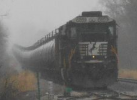
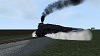
ozinoz wrote:Mike's farcebook page has some great pics - well worth a look. Finally a decent headlight projection

Just how did you get such great texturing on this loco.

I want to start re-skinning (have some bits and pieces I want to do for Tori's wonderful COA route), but looking at this leaves me in awe and feeling very inadequate...

Grant
That headlight projection took quite a lot of experimenting to get right. I found the rules and regulations from that period where they specified that the beam had to have two settings - bright for the mainline and dim for yards (and when meeting a train coming the other way, so as not to blind the engineer of the other loco) - and that on bright, it had to be capable of illuminating an object 800 feet away. So I set up a test at night, put a guy standing 800 feet in front of the loco, and adjusted the parameters of the light projection until it lit him up

So I can honestly say that my headlights comply with regulations

The texturing is hard to explain in a few sentences. I experimented a lot. It helps that I already knew a lot of tricks to use in Photoshop (from when I used to do scenery for Flight Simulator). Some of the textures come from photos, but a lot of them were created entirely from scratch by me, using lots of layers with different effects, like adding noise, blur, gradients, all sorts of things. I probably spent more time making textures than doing the actual model.
Just to reiterate what I explained to Mike, something that does help, in both exterior and cab views, is to use the shaders to maximum advantage, i.e. TrainBumpSpecEnvMask.fx and TrainSpecEnvMask.fx, but you have to spend a lot of time playing around with the texture files until you hit on the right combination of shiny alpha, image contrast, colour, brightness, blurring, highlighting, bumpiness, etc. Some of my source files in Photoshop have over 20 layers! It requires a lot of patience.
You also have to use the right size of texture for what you're texturing, and taking into account how closely you'll be viewing it in the game and whether it needs to be very sharp, like the face of a dial for which you'd use a large texture even though the part is relatively small. For the entire boiler, I used a file size of 1024x1024, but in retrospect it would have been better to use 2048x2048. That's a lesson I'll apply to the next loco.
There's one thing that is a real pain - 3DCrafter doesn't do shadow baking. So, I have to put the shadows into the textures manually. However, the model has literally thousands of parts, each with dozens of surfaces. To create dedicated shadow textures, manually, for thousands of surfaces is simply not on. I've done it for quite a lot of parts, where it makes more of a difference, but there are a lot that have no customised shadows in the textures. To counter that, I use textures with generic gradients (and I select an area of the texture with the gradient going in the correct direction, such as going from dark in a corner of an angle, to light at the outer edge) together with those rendering shaders again, with the bumpy shininess, because it actually helps to generate contrast between parts that would otherwise look flat, or just merge into each other, because of not having shadow baked texturing.
Incidentally, every one of those surfaces has to be mapped individually - using 3DC's "paint bucket" to apply a textur to an entire part in one go is a definite no-no. That's partly because it generates a mapping for some surfaces that is just a straight line, which in TSX off mode, translates into a completely black surface.